Gua sha, LED masks, derma rollers and cleansing brushes — what each tool actually does, how to use it safely, and which ones are genuinely worth your money.
No. A gentle cleanser, a suitable moisturiser and daily sunscreen will outperform any device you can buy. Tools are adjuncts — they support a good routine, they do not replace one, and they certainly do not replace a treatment.
That said, some tools are genuinely useful and enjoyable. The trick is knowing which ones carry real risk, especially if you have a deeper skin tone, sensitive skin or active acne.
Tap How to use on any tool for safety guidance and the South African context.
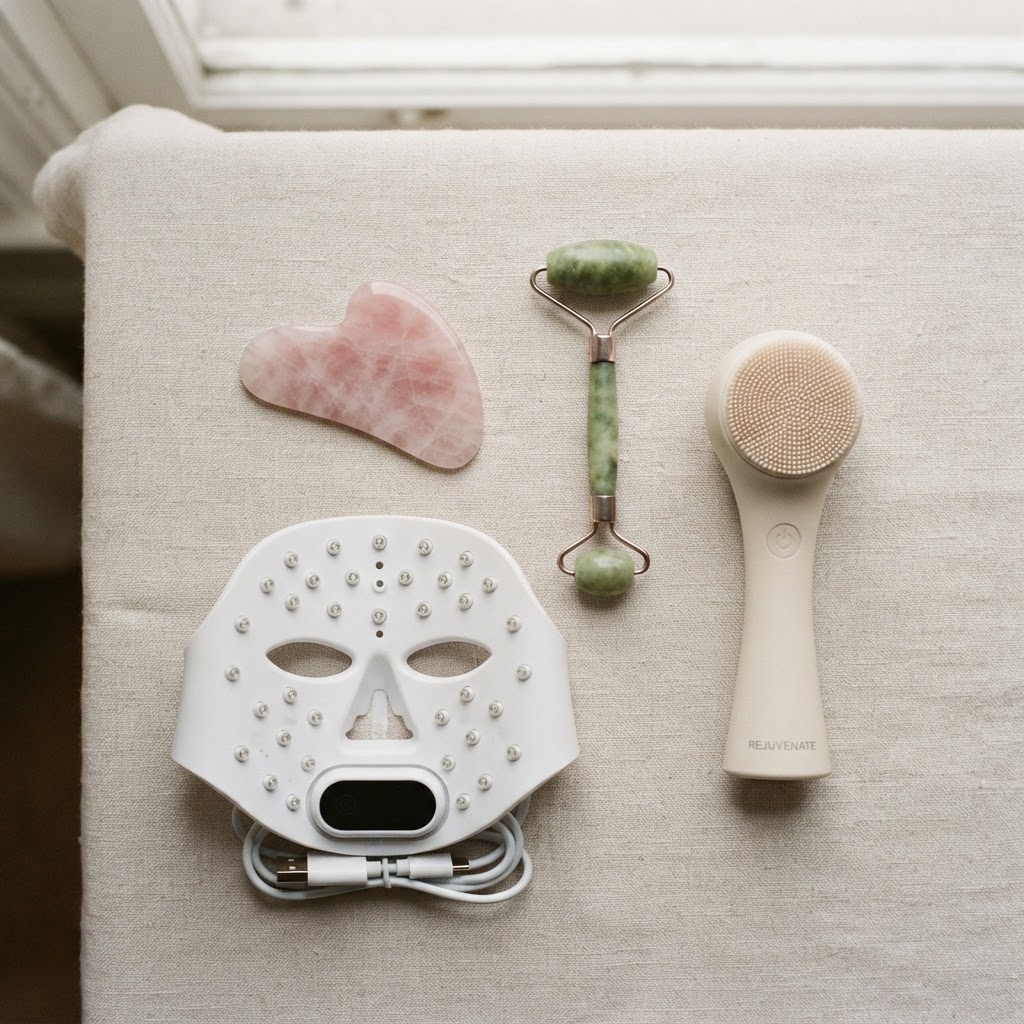
A flat stone used to massage the face along lymphatic pathways. It can reduce puffiness and help you relax, but it will not sculpt bone or replace a treatment.
Good to know: Results are temporary and mostly about fluid movement and relaxation. It is a nice ritual, not a treatment for pigmentation or acne.
Rollers offer gentle cooling massage and a moment of calm. The stone type makes no difference to your skin whatsoever.
Good to know: Choose whichever you like the look of. Jade and rose quartz have identical effects on skin.
Masks using red and blue light. Red light may support collagen and healing, while blue light can reduce acne bacteria. The evidence is promising but modest, and home devices are far weaker than clinic versions.
Good to know: If you have significant acne or scarring, clinic-based treatment will achieve more than a home mask.
Fine needles create micro-channels in the skin. In clinic this can improve scarring and texture, but home rollers are blunt, hard to sterilise and risky in deeper skin tones.
Good to know: In South African skin tones, microneedling carries a real risk of triggering pigmentation. Choose a practitioner experienced with deeper skin and let them control the depth.
Motorised brushes that deep-clean the skin. They can help with oiliness and congestion, but are easy to overuse and can damage the moisture barrier.
Good to know: Many people find their hands and a good cleanser are gentler and just as effective.
Sonic silicone pads that clean with vibrations rather than bristles. Gentler than a bristle brush and much easier to keep hygienic.
Good to know: A reasonable middle ground, but still optional — cleansing well with your hands works for most people.
Warm steam softens congestion and feels pleasant, but it does not detox the skin and can worsen redness and dryness if overused.
Good to know: Steam can soften blackheads before gentle cleansing, but it is not a substitute for exfoliation.
Chilled tools that reduce puffiness and calm flushing. Useful for morning puffiness and after a professional treatment.
Good to know: Useful and low-risk, but avoid if your rosacea is triggered by temperature swings — cooling can rebound into flushing.
Metal tools used to press out blackheads. In untrained hands they cause bruising, scarring and post-inflammatory hyperpigmentation.
Good to know: This is one of the most common causes of self-inflicted scarring and dark marks seen in South African clinics.
Silicone or electric massagers that stimulate the scalp. They feel good, may support circulation, and can help distribute scalp treatments evenly.
Good to know: Helpful as an add-on for scalp health, but hair loss needs a proper diagnosis — see a dermatologist if you are shedding significantly.
Devices that deliver low-level electrical currents. Some people report a temporary lifting effect, but the evidence for long-term change is limited.
Good to know: Effects are temporary and modest. Do not expect them to replace in-clinic treatments for firmness.
Adhesive strips that pull out surface oil and some blackheads. Satisfying, but they can irritate the skin and do nothing about the cause of congestion.
Good to know: If you enjoy them, use them rarely and always follow with moisturiser. Avoid them if you are prone to pigmentation.
Home rollers are shallow and blunt. Clinical microneedling uses sterile, controlled depth and can genuinely improve scarring and texture.
Home masks are far weaker than clinic devices. Consistent home use may help mildly; clinic sessions achieve more.
Not available for home use, and must be matched to your skin tone. In South Africa this matters — deeper skin tones need specific wavelengths.
Professional peels are stronger and supervised. At home you are limited to low-strength acids, which is exactly as it should be.
Professional extraction is safer and more thorough, especially if you are prone to scarring or post-inflammatory pigmentation.
Anything that scrapes, punctures or presses the skin carries a higher risk of triggering dark marks and keloid scarring in medium to deep skin tones. That includes derma rollers, extraction tools, aggressive scrubbing brushes and poorly chosen clinic treatments. None of this means you cannot use tools — it means choosing carefully, using less pressure than you think you need, and letting a professional handle anything that breaks the skin.
7 min read
8 min read
7 min read
8 min read
8 min read
8 min read
Skincare tools have become a huge category, and social media has made devices like gua sha stones, LED masks and derma rollers feel essential. The honest answer is that most tools are optional. A consistent routine built on cleansing, moisturising and daily sunscreen will do far more for your skin than any gadget, and tools should be seen as an addition rather than a replacement.
Some tools are genuinely pleasant and low-risk. Gua sha, jade rollers and ice globes offer gentle massage and cooling that can reduce morning puffiness, and silicone cleansing pads are a reasonable option for oily skin. Others need real caution. At-home microneedling and comedone extractors are common causes of irritation, infection and post-inflammatory hyperpigmentation, particularly in deeper skin tones.
This matters especially in South Africa, where most of the population has medium to deep skin tones that are more prone to pigmentation and scarring after injury. Any tool that abrades, punctures or presses the skin carries a higher risk here, and the wrong laser or peel settings can darken pigmentation permanently. When in doubt, let a professional control the depth and the intensity.
Whatever tools you choose, hygiene is non-negotiable. Clean every tool after every use, dry it properly, and never share rollers, brushes, extractors or masks. Replace heads and rollers as the manufacturer advises. And if a tool causes redness, pain or new breakouts, stop using it — your skin is telling you something useful.