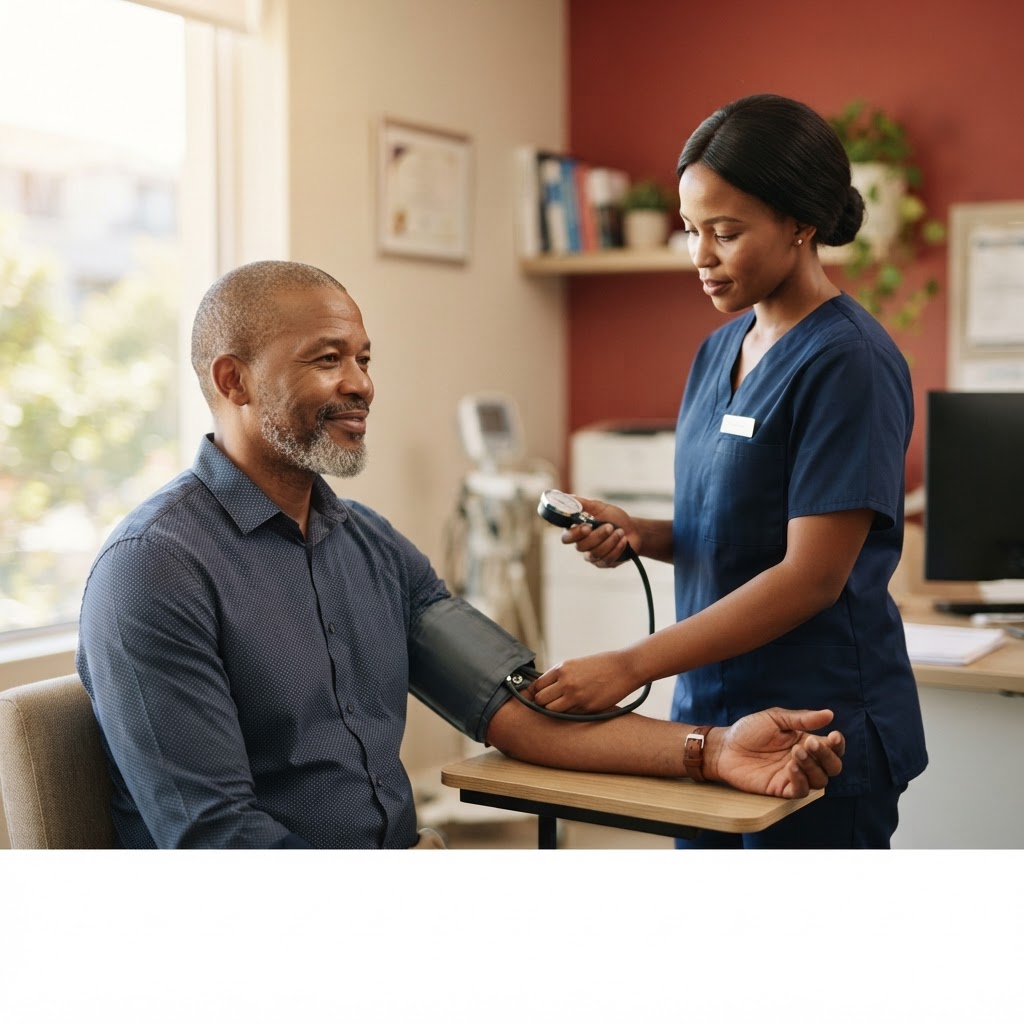
Men's Health Heart Health Blood Pressure
Blood Pressure

Blood Pressure.
The Silent Killer.

Hypertension has no symptoms but is one of the leading causes of heart attack and stroke in South African men. What your numbers mean, what raises them, and how to bring them down.

1 in 3

South African adults have high blood pressure

120/80

Normal blood pressure (mmHg)

140/90

Treatment goal for most men

Silent

No symptoms until it causes a crisis

The Silent Killer

Blood pressure is the force of blood pushing against your artery walls as your heart pumps. It's written as two numbers — systolic (when the heart beats) over diastolic (between beats) — measured in millimetres of mercury. It rises and falls naturally through the day, but if it stays high it silently damages your heart, brain, kidneys and eyes. Hypertension produces no symptoms until it causes a crisis, which is why regular checking is the only way to know where you stand.

One high reading is not a diagnosis Confirmed over several days or a 24-hour monitor Most treated men need two medicines Cheap and widely available in SA

Understanding Your Numbers

South African guidance broadly follows international targets. A single reading is never the whole story — what matters is the pattern over days and weeks.

Normal

Below 120/80

Keep doing what you're doing. Recheck at your routine appointments or at least once a year.

Elevated

120–129 / under 80

Not hypertension yet, but a warning. Cut salt, move more and lose abdominal weight now to stop it progressing.

Stage 1

130–139 / 80–89

Hypertension. Your doctor will usually start with lifestyle changes, adding medication if you have other risks like diabetes.

Stage 2

140/90 or higher

Hypertension needing treatment. Most men reach their target with one or two tablets plus lifestyle changes.

Crisis

Above 180/120

Seek emergency care immediately — especially with chest pain, severe headache, breathlessness or visual changes.

Your personal goal may differ. Most treated adults aim for below 140/90, but if you have diabetes, kidney disease or known heart disease the target is usually below 130/80. Ask your doctor what your number should be — and then aim for it.

What Raises Your Risk

Some risks are fixed and simply mean you should check earlier. The changeable ones are where the real power lies.

You can't change

But they tell you when to start checking

  • Family history: A parent or sibling with high blood pressure or an early heart attack means you should be checking from a younger age.
  • Age: Arteries stiffen with time. Risk climbs steadily from your thirties onwards — which is why checks become routine from 40.
  • Being a man: Men develop hypertension earlier than women and are less likely to be diagnosed, treated or to stay on treatment.

You can change

Each one lowers your number measurably

  • Abdominal weight: Weight carried around the middle is the strongest lifestyle driver of high blood pressure in men.
  • Salt intake: Packet soups, stock cubes, sauces, polony, viennas and salty snacks are where most South African salt hides.
  • Alcohol: More than two units a day raises blood pressure directly. Alcohol-free days help as much as cutting down.
  • Smoking: Raises pressure immediately and damages artery walls over years — the single biggest reversible risk factor.
  • Inactivity: 150 minutes a week of brisk walking can lower resting pressure by several points on its own.
  • Poor sleep & stress: Untreated sleep apnoea and chronic stress both keep pressure elevated, often under the radar.

Lifestyle That Lowers Your Number

The DASH approach works well in South Africa and can lower blood pressure as much as a single medication in some men.

Cut salt — don't add it at the table and limit packet soups, stock cubes and salty snacks

Eat more fruit, vegetables and beans — affordable staples in South Africa

Walk briskly for at least 30 minutes on most days

Lose weight if your waist is over 94cm — abdominal fat matters most

Limit alcohol to no more than two units a day, with alcohol-free days

Quit smoking — it raises pressure and damages arteries directly

Protect your sleep and manage stress with regular movement and honest conversations

Take your medication every day, even when you feel perfectly well

Measuring It Properly

Most readings taken in a rush overestimate your pressure. These five habits make the number trustworthy.

1

Sit quietly for five minutes before the reading, back supported, feet flat on the floor

2

Support your arm at heart level and use the correct cuff size — too small a cuff reads high

3

Avoid caffeine, exercise and smoking for 30 minutes beforehand

4

Take two readings a minute apart and record both

5

Use the same arm, at the same time of day, and keep a written log for your doctor

Medication, in Plain Terms

If lifestyle changes aren't enough, your doctor will choose from four main families — all inexpensive and widely available at public clinics and pharmacies. Most men need two together at low dose.

ACE inhibitors

often ending in '-pril'

Relax the blood vessels and protect the kidneys, which makes them a first choice for men with diabetes. A persistent dry cough is the classic side effect.

ARBs

often ending in '-sartan'

Work like ACE inhibitors but without the cough. Commonly used when a cough becomes intolerable or in combination therapy.

Calcium channel blockers

often ending in '-pine'

Relax and widen arteries. Very effective in older men and in men of African descent, who often respond better to this class.

Diuretics

'water tablets'

Help the kidneys shed salt and water, lowering pressure. Often the third medicine added to bring stubborn readings under control.

The most important instruction is the simplest one: take it every day. Blood-pressure medicine controls the problem rather than curing it. Feeling well is the result of treatment working — never a reason to stop it without speaking to your doctor first.

Know your number. A blood-pressure check takes three minutes at any pharmacy or clinic. Do it this week, write the reading down, and compare it over time — that single habit is how South African men catch hypertension before it catches them.

Find a Pro

Get Your Number Checked This Week

A pharmacy or clinic check takes minutes; a GP can diagnose and start treatment the same day. Find HPCSA-registered professionals across South Africa — most medical aids cover consultations and blood-pressure medication.

Browse Professionals

Blood Pressure in South African Men

Roughly one in three South African adults lives with hypertension, and men aged 35 to 60 are among the highest-risk groups. Yet a large share of them have no idea. Studies such as CRAVE and ACCESS have repeatedly shown that awareness, treatment and control rates in South Africa remain poor — not because treatment is unavailable or expensive, but because the condition is silent and men rarely check. The burden falls hardest on urban communities, where salt-heavy diets, stress, alcohol and abdominal obesity stack on top of each other.

That silence is what makes hypertension so dangerous. You can feel energetic and well while your arteries are stiffening and your heart muscle is thickening under the strain. Uncontrolled high blood pressure is the single biggest contributor to heart attacks, strokes, heart failure and kidney failure in South African men, and it damages the vessels in the brain and eyes over years. There is no warning until there is an event.

The encouraging flip side is that pressure responds quickly to treatment. Even modest reductions dramatically cut the risk of stroke and heart attack, and the medicines involved are among the cheapest in the pharmacy — generics widely available in both the public and private sectors. Lifestyle changes can lower pressure by as much as a single tablet in some men. The one thing that makes all of this fail is stopping treatment because you feel fine; the whole point of treatment is that you feel fine.

For South African men the practical message is simple. From age 40, have your blood pressure checked at least once a year — earlier if you smoke, carry weight around the middle, drink regularly or have a family history. Learn your number, write it down, and compare it over time. If it’s raised, get it treated and stay on treatment. High blood pressure is common, silent and serious — and it is also one of the most controllable threats to your health.